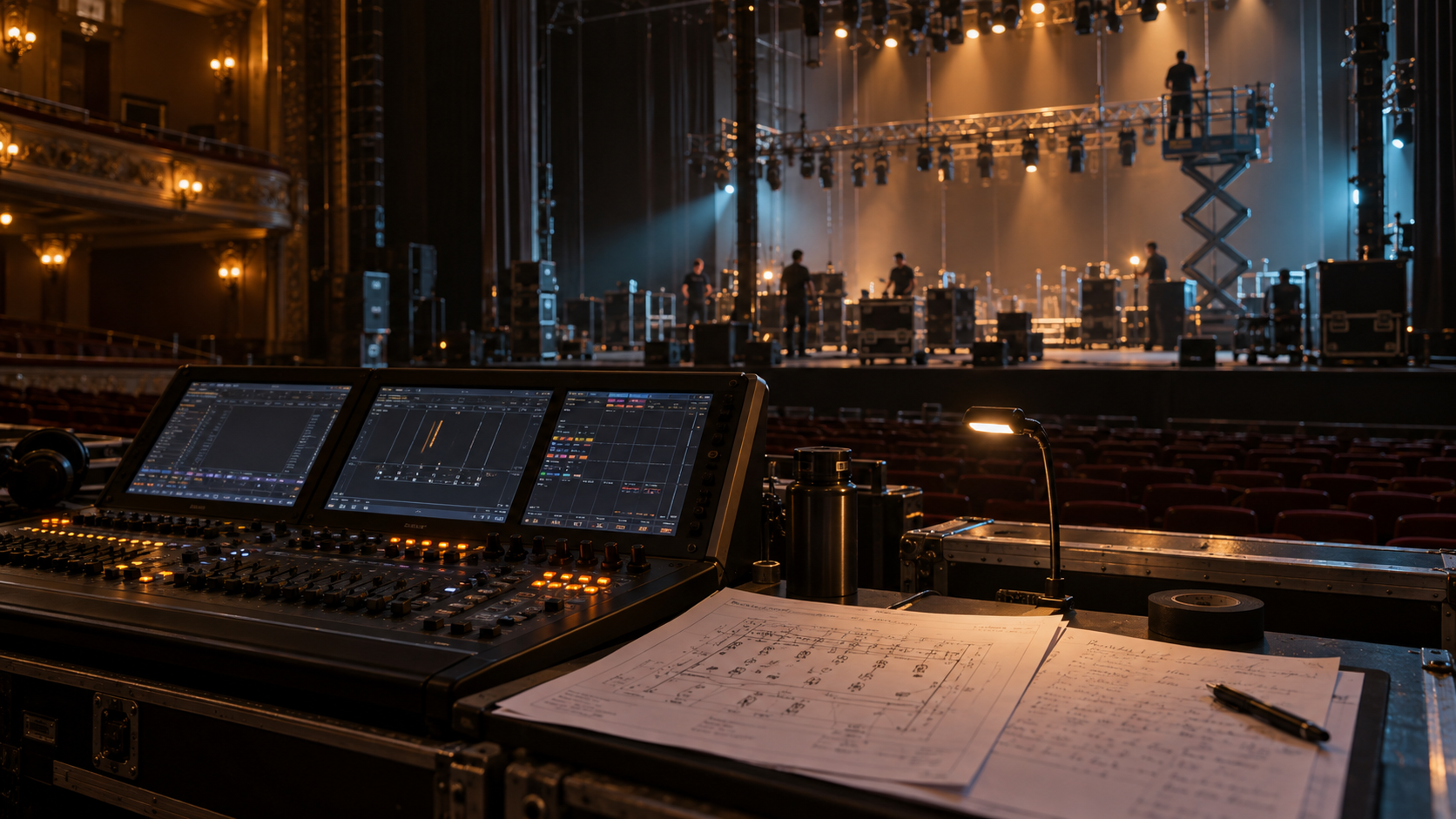
The audience recognizes the start of a show when the first light comes up. For the technical team, however, the show began days earlier: in a drawing, a phone call, or a question someone decided to ask in time.
Preparation you can measure
Fewer patch corrections during load-in, a clean first connection, identified open items, and recoverable backups are concrete signs. So is being able to dedicate rehearsal to intention and coordination instead of rebuilding basic data.
Before travelling, it is worth imagining the first hour: what information each person will need, which failure would prevent progress, and which decision has no owner. Advance work does not remove uncertainty; it creates room to respond when reality changes.
When everything works, that preparation disappears. What people see is a clean transition, not the decisions that prevented rehearsal from becoming an investigation.
The first cue happens in an email
Before opening a show file, you need to understand the project. A gala, a tour, a musical, and a corporate presentation may share equipment, but they do not share the same pace, priorities, or tolerance for change.
Information rarely arrives in perfect condition. The drawing may be out of date, the equipment list may omit DMX modes, and two departments may each believe the other is providing a signal. Everything seems minor until several people build on different answers.
Asking which version is approved, who manages the network, whether there will be timecode, and which software will be used does not slow the work down. It prevents an assumption from reaching load-in disguised as a decision.
Preparation is not programming twice
Preproduction is not an attempt to finish the show without seeing it. It resolves everything that does not require the stage and reserves on-site time for what genuinely depends on reality.
You can prepare the patch, groups, names, views, presets, and backups; verify fixture types, universes, and versions; and identify what is confirmed, provisional, or pending. None of this prevents later changes. A clear structure makes change easier.
One missing line can stop an entire morning
Imagine twenty fixtures whose mode is missing from the list. The supplier delivers a different revision. If discovered beforehand, one confirmation is enough. If discovered during load-in, addresses, patch, libraries, presets, and documentation must all be changed while the stage waits.
The original error was one missing line. Its cost multiplies because production, performers, and departments are all in the same place at the same time. This is why advance work pays for itself even when nobody sees it.
Preparation also has limits
Not everything can be settled in advance. Artistic decisions and substitutions will remain. Trying to resolve every detail can be as unproductive as preparing nothing.
The useful approach is classification: confirmed information becomes structure; provisional information must be able to change without breaking it; pending information needs an owner and a decision point. Preparation does not remove uncertainty; it makes it visible and manageable.
The backup starts beforehand
A backup is not simply saving twice. It means knowing which version is current, which software created it, and how to continue if equipment fails. It includes the network, external files, and essential libraries.
Testing a backup may not feel exciting. Discovering during the show that it will not open is far too exciting. If something is essential, it belongs in the plan, not on the list of things we hope will work.
Invisible work protects rehearsal
Rehearsal brings performers, technicians, space, and time together. Using it to reconstruct verifiable data means buying administrative information at the price of the entire assembled team.
A rehearsal should reveal stage relationships, not rediscover what was written in an email. Every hour of preparation gives attention back to observing, listening, and deciding.
Arrival is not the beginning
Someone who arrives and works from the first minute did not begin at that moment. They bring organized information, tested tools, and identified questions.
Preparation does not guarantee that there will be no problems. It stops predictable ones from occupying the space reserved for unavoidable ones. The show begins when someone turns files, conversations, and doubts into a shared plan. When the console powers up, that work disappears into something that looks simple.